





 16 JANUARY - 28 FEBRUARY 1999
Rineke Dijkstra
The Buzzclub, Liverpool, UK/Mysterywold, Zaandam, NL
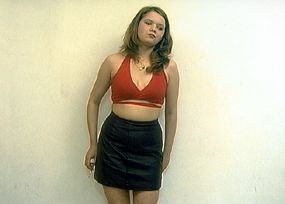 still from Rineke Dijkstra The Buzzclub Several years ago Galleri Index showed a suite of exhibitions that, in various ways, concerned the lives of young people. Previously we have shown exhibitions by Larry Clark ("Tulsa" and "Kids"), photographs by Collier Schorr, a video installation "If 6 was 9" by Eija-Liisa Ahtila and earlier this autumn Pål Hollender's film "Pelle Polis". Dutch artist, Rineke Dijkstra's video installation "The Buzzclub, Liverpool, UK/Mysterywold, Zaandam" (1996-98) is yet another work in this series that we have the privilege to show. Rineke Dijkstra has in recent years received acclaim for her portraits, not least for the pictures of youths and children on a beach. Each one has been photographed standing in their bathers on the seashore before the water. The pictures are taken with a large format camera and the revealing light gives an artificial impression. These portraits give an impression of having been taken in a studio rather than out in nature. The people portrayed are the photographer's object of investigation. It is no accident that one of Dijkstra's role models is Diane Arbus, here too is a strong element of empathy and desire to understand that one also finds in Arbus. But in Dijkstra's case it is slightly surprising because the first impression is that there is a palpably clinical direction in the pictures as they so clearly subscribe to a naturalistic tradition. The video work "The Buzzclub, Liverpool, UK/Mysterywold, Zaandam, NL," now showing at Galleri Index, is an evolution of these photographic portraits. It consists of two projections shown side by side. Dijkstra has filmed youths in two clubs, one in England and one in Holland. In a room behind the dance floor she has invited a number of the dancers to individually pose in front of the camera and dance, alone, to the deafening techno. What becomes apparent with these teenagers is that which Diane Arbus called the difference between 'intention and effect': they adopt an attitude in front of the camera and what we see is exactly that they want to be (tough, mature, adult) and what they are (teenagers swaying precariously on the edge of adulthood). At first they stand still in front of the camera, then they start to dance carefully to the techno. Some are obviously shy, others are more reckless. One girl begins slowly, careful to dance and gain ground and then to dare, becoming more extrovert and wanting to be seen. She is seen by Dijkstra and she is seen by us, the audience. Another girl has a mohawk, dressed in combat clothes and performs a hard-core, monotonous dance. We understand how she wants us to perceive her. She dances in an eternity. But she cannot carry on, a tiny smile appears for a moment. Then she returns to her rite. As two films are shown parallel to each other, one from each club, we compare the dancers. There is no escaping that they are subjects in a kind of anthropological study. Yet they arouse our empathy for they are visibly in the gap between adulthood and childhood and because we too are them. Andreas Gedin Rineke Dijkstra has had a number of separate exhibitions in Europe and in the past two years has, among others, taken part in exhibitions such as "Future, Present, Past" at the Venice Biannual 1997, "New Photography 13", The Museum of Modern Art, New York 1997, "Wounds", Moderna Museet, Stockholm 1998 and the Biannual in Sao Paulo, 1998. |
|


