





 OCTOBER 8 - NOVEMBER 16, 2003
Johanna Billing:YOU DON`T LOVE ME YET
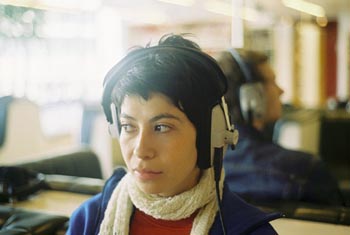 © Emanuel Almborg In her projects, Johanna Billing often works with people who participate as themselves and contribute their experiences in a mixture of scenes, both staged and documentary in form. Here too, the viewer plays a role, as the works often originate in a social environment where co-operation and participation are part of the total experience. In the artist's film and art project "You Don't Love Me Yet", concepts about the individual and the collective are unified into a positive opportunity. The catalyst for this interaction is an 80s pop song, "You Don't Love Me Yet" by American singer-songwriter Roky Erickson where - despite the disillusioned tone - a feeling of trust and hope is discernible between the lines. The project commenced in October 2002 with live performances at Index, including more than twenty participating singers, soloists and a wide variety of bands. Roky Ericksson's song was covered again and again, reflecting the participants' own personal style. The project's second part, Johanna Billing's film "You Don't Love Me Yet", produced in June 2003, reunited the participants only this time the individual performance is replaced by a common effort at Atlantis recording studios in Stockholm, where both a film and audio recording took place. The film, now showing at Index, lies somewhere between a music video and a documentary, with emphasis on the common performance. In autumn 2003, the film is being exhibited at six locations in Sweden, in collaboration with art institutions who, like Index, have also acted as co-producers. By themselves, or together with local music managers and youth organisations, they too will host concerts, based on the theme of the local situation for art and music. Despite a relatively fixed structure, in other words, repetition and personal interpretation as a strategy, each participant - private individuals as well as organised institutions - has the opportunity to determine their own part of the project from the point of view of their possibilities. The project also includes an audio CD containing the recorded song, which will be distributed free of charge. The film will furthermore be screened in connection with live performances at Frieze Art Fair, London 17 – 20 October, and furthermore at KIASMA, Helsinki in November. The film "You Don't Love Me Yet" is produced by Index in collaboration with Nifca, Helsinki. Curated by Helena Holmberg and Mats Stjernstedt, Index. Co-producers and collaborative partners for the film and tour are Eskilstuna's Konstmuseum (with Balsta Musikslott), Norrköpings Konstmuseum (with Allmän Kultur, Norrköping), Konstkonsulenten in Jämtlandslän (with Mångkulturkonsulenten and UKM), Konstkonsulenten in Västra Götalandsregionen (with Vara Kommun), Gävle Konstcentrum (with Musikhuset and Kultur och Fritid) and Ystad Konstmuseum. The book "Johanna Billing - Works" is published in a collaboration with Index and Milch Gallery, London, with support from IASPIS. For more information and press pictures, please contact Index. The Index exhibition programme is curated by Andreas Gedin, Helena Holmberg, Mats Stjernstedt and Niklas Östholm A conversation between Johanna Billing and Helena Holmberg, curator at Index. Helena Holmberg: Starting initially from a need to redefine Index curatorial practice, we invited you to work with us, a collaboration that now, after about two years, has reached its second stage: The You don´t Love me yet tour, with support from Nifca. As I remember it, right from the start you wanted to work with music. You suggested this song by the American singer-songwriter Roky Ericksson: You Don´t Love Me Yet. Why this song exactly? Johanna Billing: Actually, it was a mere accident that it ended up being a music project. I happened to hear the Roky Ericksson song, which is about love and relationships in both a hopeful and disillusioned way, about the same time as I heard on the radio that Sweden has the highest number of single-occupancy households in the world. That made me reflect on just how highly we value independence. I've been brought up in an era where it's almost ugly to be dependent on someone. This applies not only to love matters, but in other areas too. It can be exceedingly difficult to let go of oneself and one's own selfish interests. HH: The first stage of the project was a full-day, live concert at Index in October 2002, where everyone performed their own version of You Don´t Love Me Yet. The musicians from this event then returned to appear in the film and the CD, which was recorded in May this year, this time as a group performance. Can you tell me something about the musicians themselves and why you chose to collaborate with them? JB: It felt natural inviting musical artists to make a cover version of the song, because then you take one step away from yourself and focus on someone else, enter someone else's world. In the music world, it's not so usual for bands to be asked to keep within certain parameters, as it is for example, when an artist is invited to participate in projects and exhibitions. I made a decision to invite musicians and bands, mainly from the alternative pop and rock scene in Stockholm, people who I thought would get something out of this. HH: This project is mostly based on collaboration between the art scene and the music scene. You and your brother have run a small record label together for several years, but previously you kept this activity separated from your art. What's it been like combining the two? JB: My decision to keep music separate from art was based largely on a fear that the art world sometimes handles music a bit strangely. People are most interested in the actual record label. But this project is centred around the act of establishing a relationship to another musician. The whole project is imbued with enormous respect for the original song and Roky Ericksson. In that way, musicians from a variety of areas can come together without losing their integrity. HH: Now we're on tour, covering six towns in Sweden and abroad too. In each location showing the film, there's a new concert organised in collaboration with the local music scene. Everyone we work with is going to make their own interpretation of the project. They'll also place a different emphasis on the various parts that make up the entire project. Some are going to profile the film, others the process itself and the concerts. What's your opinion about this? JB: One of the initial concepts about the project was repetition, that "You Don't Love Me Yet" is repeated time and time again, in different forms, almost like an incantation. But this repetition cannot just be about doing something again. I hope everyone feels that it's about extending a project and the new versions work as additions and commentaries. HH: As I mentioned by way of introduction, the initial point of Index's involvement was to find a new way of working. We wanted to build a long-term collaboration and make the gallery accessible to process-orientated work, even regarding our role as exhibition producers. Now we find ourselves in quite a roving situation and the project is constantly changing and new threads are spinning off in all possible directions. Even if the entire project is clearly based on a simple, common model, there is at the same time the sense of working with an unfinished script. As an artist, how has it been for you? JB: For me it feels natural working with a project for a long time and it's exciting having so many components in a project and at the same time activating something so open and motley. The collaboration between the organisers is also interesting, as they now make 'cover' versions of the first concert in their respective towns. Obviously, there's a double-emotion connected to it, but still that's what the project has been about since the start. I find it exciting - and quite right - that in part even I must relinquish control over the way I work with exhibitions and events. Of all the various parts of this project, I think that is the most exciting one, trying to create a more flexible form for how things are shown and one in keeping with the content. HH: We ought to finish by saying something about the film itself, which is just as important to the project as the concerts. The film contains another aspect of this open way of interacting which we've been talking about. In this case it's about making the most of those qualities that appear in the context of the recording studio and letting them carry the finished work, without being perceived as documentary in style. What's your opinion about the relationship between reality and fiction? JB: It contains elements of both reality and fiction. The musicians are themselves, but the situation they find themselves in is kind of surreal and becomes a kind of fiction. So even though it's filmed in a very straightforward manner, I'm more interested in portraying the emotion that arises from finding yourself in this situation, than the situation itself. HH: The film also has a complexity, a nerve, which I interpret as coming from the tension that occurs in the gap between the formal, skilful cinematography and the slightly nervous participation of those being filmed. I wondered if this distance was something you used consciously during the filming? JB: Yes, I am interested in the ambiguity found in the song and in the way the song is performed. All the musicians are in the studio together, however during the actual recording each one is isolated in his or her own headphones. The distance you mention also comes from my attempt to create some kind of cinematic filter, a fiction between the camera and those being filmed. It's all based on respecting the participants - since they find themselves in a situation where they don't have full control, it is crucial to show that this event is being partially directed. In such a way, the film oscillates between the obvious performance and the vast range of interpretations that arise out of this art form. Helena Holmberg Sept. 03 This article also appears in an issue of Nifca Info. |
|


