





 5 MAY – 10 JUNE 2001
Michael Elmgreen & Ingar Dragset
Galerie Klosterfelde
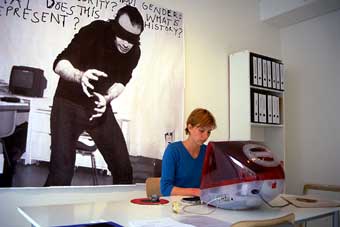 © Michael Elmgreen & Ingar Dragset The works of Michael Elmgreen & Ingar Dragset represent an ongoing investigation of established structures in society. Their many performances and installations can be interpreted as a series of proposals about how these structures could be disrupted and broken up. In their exhibition at Index they are, as in many of their earlier works, focusing on underlying structures in the art scene. On this occasion, they have moved one of Berlin´s commercial galleries, Galerie Klosterfelde, to Index. Nikola Dietrich from Klosterfelde will turn part of Index into her office; herself and her work making up part of the exhibit. The work also includes a group exhibition of Galerie Klosterfelde´s artists, as selected by Michael Elmgreen & Ingar Dragset. These chosen pieces complement their work dealing with issues involving the exhibition process, the art scene and the art gallery as an institution. Michael Elmgreen says in an interview with Hans Ulrich Obrist: "no structure is able to suppress anyone, not the structure itself. It´s only how you deal with the structures already being there, an all structures can be altered or mutated". Helena Holmberg A conversation between Michael Elmgreen & Ingar Dragset and Helena Holmberg The group show represents the following artists, including Michael Elmgreen & Ingar Dragset themselves: Matthew Antezzo (USA), John Bock (Germany), Stefan Hirsig (Germany), Christian Jankowski (Germany), Ulrike Kuschel (Germany), Peter Land (Denmark), Nader (Iran), Henrik Olesen (Denmark), Dan Peterman (USA), Kirsten Pieroth (Germany), Steven Pippin (England) and Vibeke Tandberg (Norway). Michael Elmgreen (Denmark) & Ingar Dragset (Norway) have worked together since 1995. In recent years their work has been shown at: Nuit Blanche, Musée d´Art Moderne, Paris (1998), Manifesta III, Ljubljana (2000), Galerie für Zeitgenössische Kunst, Leipzig (2000), What if..., Moderna Museet, Stockholm (2000), Portikus, Frankfurt (2001), Galerie Klosterfelde, Berlin, Galleri Nicolai Wallner, Copenhagen and other galleries and institutions. They will also be participating in the Sao Paolo Biennial (2002). Thanks to CDB & the Goethe Institute, Stockholm. A conversation between Michael Elmgreen & Ingar Dragset and Helena Holmberg Helena Holmberg: Your works often feature cultural and geographical contexts, quite frequently they are a reaction to a local situation. For example, "Dug Down Gallery/Powerless Structures, Fig. 45", was a comment on the shortage of commercial galleries in Reykjavik. You are quite familiar with the Stockholm art scene, having both had stipendiums at IASPIS, spring 2000. So what is this exhibition reacting to? Michael Elmgreen: One could say that Stockholm´s gallery scene has experienced a kind of "meltdown" in recent years, even though some of the more serious galleries have survived. On the other hand, Stockholm has a higher number of good public art institutions than Berlin. There, the galleries have assumed responsibility for staging interesting and experimental exhibitions. But our project of moving gallery Klosterfelde and its activities to Index obviously cannot be regarded as a "reaction" of any kind. In itself, it proves that the structures of the art scene are more mobile than we think. A gallery is not just its physical space or its presence in a definite location. It is also its artists, its programme and its position within the international art world. If all of Klosterfelde1s artists exhibit at Index, suddenly Index becomes Klosterfelde. HH: Your work has often focused on disrupting and changing the established structures of the art world, this time by moving a commercial gallery, Klosterfelde, from Berlin, to a non-commercial space for contemporary art, Index. Comparisons could be drawn with your work for Manifesta 3 in Ljubljana, a town similar to Reykjavik in that it lacked commercial galleries. In Ljubljana you built a commercial gallery inside a museum. Unlike the work in Reykjavik, this gallery was operational. You had a programme and you even recruited a group of people to be gallerists. Between these two works, a shift has taken place, from the gallery as an object, the white cube, to the gallery as an enterprise. Have you become more interested in the actual workings of art galleries? Ingar Dragset: The architectural and social structures cannot be isolated from each other. There is a reason why the "white cube" looks the way it does. Or rather, many reasons. We´ve always been interested in investigating why things function as they do in the field we label contemporary art: The decisions that are taken in the process of presenting art. We gladly reveal just how vacuous some of the most conventional rules are in the art world, while at the same time, on a visionary level, we are interested in bringing about real change in the traditional structures. At Galerie für Zeitgenössische Kunst in Leipzig, a public art space, we used our production budget to employ two unemployed painters from the city to paint the entire art hall white, again and again, and by the end of the exhibition they had laid down 35 coats of paint. On one hand, it was a statement about the antiseptic and slightly too fashionable architectural framework of the place, which was in stark contrast to Leipzig´s social problems. And on the other hand it was a platform for those two unemployed painters, who didn1t just get work during the exhibition, but were given jobs afterwards. HH: The installation in Ljubljana was, like many of your works, an intrusion in the context of the social and economic references. But what were the consequences? Did the temporary existence of a commercial gallery inspire anyone to open a gallery in Ljubljana? ME: Actually, I was talking on the phone to Spela today, one of the girls who helped running the gallery during Manifesta, and she has been asked to be a co-curator for the town1s Graphic Biennale, which is normally ultra-conservative, but this year it is being organised by the Museum in Progress from Vienna. And she is curating shows in different places in Ljubljana together with some of the artists we exhibited in our gallery project. She came to see us in Berlin during the art fair and made lots of contacts, and when the finance is available she plans to open her own gallery. But it is not easy in Ljubljana. It has no tradition of collecting contemporary art and therefore there is no art market. HH: Your work at Index utilises an existing space for contemporary art that is hosted by an existing art establishment. What separates your work from our usual activities at Index is going to be quite ambiguous. How does this affect the work? ME: Well, it isn´t going to be one of those "cash & go" shows and not a show that could be acquired easily by a museum. The work is the daily activity of the gallery and the actual relocation of this activity. Actually, this exhibition is not about Galerie Klosterfelde, but about Index. It´s a contrast to the exhibition we have just had at Klosterdelde, which recently changed address in Berlin. Our exhibition there was an exact reconstruction of the old gallery space in the new location. The audience who came to see the new place were taken by surprise by the familiar surroundings. HH: One could also consider your project at Index as the transportation of a little bit of Berlin to Stockholm. Quite practically, that means increased contact between the two art scenes. Is that an interesting aspect of the project for you personally? ID: Every Swedish artist ought to move to Berlin. Things are cheaper there and the art scene is more challenging. On a daily basis, art is taken much more seriously. Even if you´re just going to Deutsche Bank to apply for a credit card and you tell them you are an artist. It´s certainly got something to do with art being more integrated into the society, of the social economics. Contemporary culture is a vital part of German society, maybe due to Germany´s tragic history which creates a bigger need for "the new". In the Scandinavian countries it feels like visual art, theatre and literature are regarded as something "extra", something outside everyday life. HH: Your project at Index could be considered as two parts: firstly, the gallery Klosterfelde1s move to Index, a work created by you as artists, and secondly the group exhibition by Klosterfelde1s artists which you have curated and is showing at Index during the exhibition period. The group show can be considered both as a separate entity with you as curators or as an element in your own work as artists. In recent times, much has been said about the role of the curator in contemporary art. One common opinion is that the curator uses artists1 works like colours on his own palette. At Index, the works of other artists become elements of your own work. How do you see this issue in relation to your work? ME: We don´t think it has any relation at all to such discussions which, by the way, seem paranoid and naive to us. Why shouldn´t a curator profile his own personality through the curated exhibition? The artist does it through the artwork. And artists can always reject to participate if they are suspicious of being used as an instrument in someone else´s orchestrations. But in this case, we know all the artists really well because we all belong to the same gallery and therefore our role is quite different from that of a curator´s. HH: Many of your works contain an element of performance. At Index, Nikola Dietrich from Klosterfelde is very much part of the exhibition; her office, her person and her work. I´ve read that you would rather people see your works as "live installations" than performances. Is that right? ID: We started our collaboration by making performances together. Michael comes from a visual art background, myself from the theatre. Performance in a visual art context was a natural combination of this. We joined forces mainly because we wanted to do something together, we were already a couple and much too occupied with our separate professional engagements. It seems almost by chance that we´ve been able to carry on, yet we´ve worked together for 6 years now. Because neither of us has an art school education it doesn´t matter to us if we work in one artistic field or another. The advantage of working with visual art, compared to working with theatre, is that the means of production are more flexible and cheaper. Partly because everyone is underpaid, but also because you work with smaller entities in the art world. You are able to generate new ideas faster than in the theatre, for example. There every new idea costs several million to produce and that1s why theatre as an institution is lagging behind. HH: At "The Project" in New York, you made a work, Fig. 60, that utilised space and people not normally associated with the gallery. Shutting off part of the gallery by building a wall and opening up that space to the street, transformed part of the gallery into a place that became part of the street scene, a place that was above all seen and used by those living in the area. What was especially interesting was that this neighbourhood was not considered safe to visit by the mostly white art audience. What relation does your work have to social and political discussions? ME: We consider every artistic statement to be part of a political and social discussion. Some try to avoid a political role, choosing not to directly refer to the political or social in their work. But even this decision is a highly political statement. Personally, we would find it arrogant to just go around the world dumping our art about the place without any consideration of the local context. Not just the specific art institution or that town´s art scene, but also the social context surrounding the exhibition. The same artistic work as a different meaning if it is shown in Japan or in Harlem. In Japan, we made a replica of the Hollywood sign, only we changed the word to Harlem. It would have been pathetic to show that work in Harlem, disregarding the fact that there are no hills on which to locate the sign. However at the Triennale in Japan, the sign made sense, an ironic criticism of the mindless cultural exchange that often takes place at such giant art expositions. What is actually being exported and what do the organisors want to import? Furthermore, Japanese society is quite xenophobic in many ways and demographically homogeneous. 100 artists were invited to produce environmental works in an area outside Tokyo, an area inhabited by poor rice farmers and visited by rich tourists from the city who want to experience the traditional "picturesque" wooden houses of these farmers. The aim of the exhibition from the organisers point of view was to "help revitalise" the area, making it even more attractive to cultural tourists. Something that the former mayor of New York was also into at that time, concerning Harlem: Just give them a Starbucks and a Tower Records and tear down the worst apartment blocks and that´ll get the property developing and restoration going... The upper middle class of Manhattan has already started going to Harlem to eat soul food. HH: The issues about how a place´s importance and meaning is constructed is the core of your work. So too, its sexual connotations and how relations to this are formed. I´m thinking about ´"Cruising Pavilion" the room you built in a park near Århus (1998) as a comment on outlawed, outdoor sexual activity, a restriction that perhaps mostly affected homosexual men who had already been reduced to employing these kind of environments. These issues do not occur in your work at Index. Has it become less important to you over time, or is it simply less visible in this work? ID: We continually work with sexual politics as a theme in most of our works, most recently, for example, in an exhibition at Witte de With in April. But just because someone is gay and committed to issues concerning representation, identity, etc, doesn´t mean that you always have to work with that theme. There is so much more to someone´s individuality than just his or her sexual identity. The work you referred to, "Cruising Pavilion" contained lots of other themes and conceptual layers, for instance public space versus individual behaviour. HH: In the magazine, NU (1:99) Franklin Sirmans approaches your work in the context of Nordic art. He lists a number of characteristics typical in Nordic art: melancholy, socialism, institutional criticism, purity of form, etc. Are these associations something you yourselves would make? ME: Like most other Scandinavian artists, we grew up in rigid, purely institutionalized environments: Well-designed kindergartens with ergonomically correct toys, supervised by qualified pedagogues, schools with Arne Jacobsen chairs for children and free milk in the lunch break. Just like everyone else in these countries, we get annoyed if the bus is late or if it is overcrowded. Functionalism is such a dominant part of Nordic culture that it would be odd if it hadn´t influenced our perception of the world. In other parts of the world, for example in Mexico City, you see that the society is capable of functioning in a completely different way. Many people live on the streets and poverty is visible everywhere, yet in Scandinavia a proportionally higher number of people commit suicide or die of boredom. Many of our works have a visual trace of Scandinavian functionalism, even if the objects are made non-functional. |
|


