





 SEP 4 - OCT 3 , 1999
Pierre Huyghe
L'Ellipse
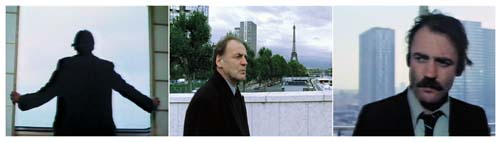 stills from Pierre Huyghe, L'Ellipse In Wim Wenders' film 'The American Friend', train stations, airports, journeys and transfers play an important part. The transition between various states, not least that between life and death is a central theme. About midway through the film, Wenders has chosen not to portray what could be considered the film's most central transition. The main character, played by Bruno Ganz, moves between two apartments each on either side of the Seine in Paris. On the other side of the river he will receive information about the status of the fatal disease he is suffering from. If the tests are bad he will accept a mission as a hired killer. In the film the movement between these two places is replaced by a cut, a gap, that the viewer himself must fill with content. Pierre Huyghe uses Wenders' film as the initial inspiration for an experiment: He lets Bruno Ganz, twenty years older, walk the route we assume his character took. The man who dies in the end of Wenders' film is back in the middle of his narrative - at the same time as his age places him at a time after the story. The symbol of death, the passing over the river, is repealed at the same time as it is shown. In an interview with Jérôme Sans, Pierre Huyghe describes this movement as a chronological ellipse. (1) The fascination for movement and transition can be seen in most of Pierre Huyghes' work and he has also often chosen to recycle a film already in existence as raw material. His work can be considered as the active viewer's suggestion of further development and interpretation. Pierre Huyghe is part of the young generation of French artists that have received much attention in recent years. In this year's Venice Biennial he participated with a film project together with Dominique Gonzalez-Foerster and Philippe Parreno. In this new work L'Ellipse has been used again, transformed and confronted with a new context. Helena Holmberg (1) This interview can be read at www.aarhuskunstmuseum.dk Welcome! Pierre Huyghe will be present at the opening. |
|


