





 7 OCTOBER - 12 OCTOBER 2000
Joseph Grigely
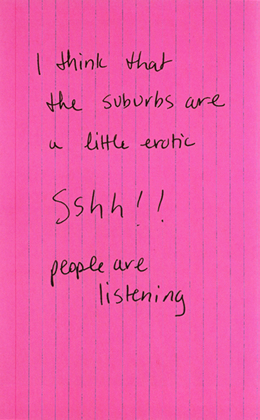 © Joseph Grigely The first work I ever saw by Joseph Grigely was a table covered with what remained from a social gathering. Bottles of coca-cola, full ashtrays and dirty dishes. And as well, spread out around the table, fragments of handwritten text; individual words and sentences written on serviettes, newspaper and notepads. I wouldn1t be surprised if this was also what Joseph Grigely himself saw as he started tidying up after an evening with some friends, when suddenly it struck him that this too was a work of art. Gathered together here were vital elements of his own life as an artist: communication, sociality, documentation and the fact that he had turned deaf at eleven years of age. Joseph Grigely talks and lip-reads. But sometimes, there are misunderstandings and certain things need to be clarified. That1s when people write notes for Joseph. Sometimes it is a little story, sometimes a complete sentence, but mostly it is just a few, individual words. These notes comprise the core of Grigely1s work. These fragments of past conversations are linguistic snapshots saved by the artist / archivist. The messages can be totally incomprehensible, yet also deeply personal. Sometimes the paper that the text is written on is itself the message. It could be a check from a restaurant in Birmingham, a serviette with a logo, a ticket from a museum, the backside of an opened envelope... After viewing the fragments of text, it becomes apparent that they do not come from the artist1s own hand, but from those who are around him. As a viewer / reader, we are put in the artist1s situation. We are the receivers, the messages are directed at us. Just like the artist, we stand in silence, in the eye of the storm surrounded by a whirlwind of words. This silence is closely related to melancholy. Probably, it has something to do with the passing of time; these messages move us in the same way as photographs sometimes do. It is too late, after the fact, the party is over - this time. Andreas Gedin A conversation with Joseph Grigely Joseph Grigely was born, 1956, in Springfield, Massachusetts, USA, and lives and works in Jersey and Michigan, USA. He has had a number of solo shows including, Anthony d1Offay Gallery, London, and Musée d1Art Moderne in Paris. Group shows during 2000 include the Whitney Biennial, Museum of Contemporary Art, Los Angeles, Matthew Marks Gallery, New York, Portikus, Frankfurt, Kunsthaus, Zurich, and the Biennials in Venice, Istanbul and Sydney. Grigely is represented by Cohan, Leslie and Browne Fine Arts, New York. He teaches Art and Critical Theory at the University of Michigan, Ann Arbor. A conversation with Joseph Grigely by Andreas Gedin and Mats Stjernstedt Andreas Gedin: Using your very specific situation - being deaf - in an art context differs you from most other artists. Do you find it problematic in any way that your handicap is in focus and that it could take over other aspects of your art? Joseph Grigely: Good question. I suppose it "is" problematic that people attach themselves to the matter of my deafness, but it is also perfectly understandable - it's a salient and inescapable reality. It bothers me only when people aggrandize the deafness and invoke platitudes about it. Over time, the emphasis on deafness tends to dissipate as people discover the work that I make is much less about me than it is about the people with whom I have conversations. For me, the whole process of conversing on paper is 'normal' - an ordinary daily activity that actually inverts the idea of disability: when I ask people to write things down, their normal process of conversing is changed; they have to converse in a way that disables their normal mode of communication - so they become disabled somewhat - finding that everything they want to say must depend on the words coming from the tip of their pencil - . AG: If I have understood you correctly, then suddenly, in the beginning of the nineties, you realised that the notes you received from people around you (i.e. the written messages you get from people you converse with when you don't understand words by lip reading), that this was something you could work with? JG: Yes, that pretty much describes the situation. When someone says something to me I usually reply 'I'm sorry, I'm deaf, would you write that down?' For years it was a habit to say 'I'm sorry,' because I was inconveniencing people - disrupting their preconceptions about normalcy - sort of like when you forget your watch, you might say to someone, "I'm sorry, can you tell me what time it is?" . The turning point came one evening when I had dinner with a friend - one of those really long dinners that seems to last forever - and when we were done there were papers everywhere - what seemed like hundreds actually - and I saved them - and the next morning I spread them out on the floor of my studio, and it struck me that they didn't look at all like writing in any conventional sense: sometimes the words ran off the page; sometimes the words ran up against each other; sometimes there were words on top of words; sometimes there was only one single solitary perplexing word. Everything had the semblance of being a conversation, with the usual and natural discursiveness of a conversation - and yet it was all inscribed - some kind of talking on paper. Over a period of a few months I saved all of my conversations - which felt strange because I had been throwing them away for twenty years - and spread these on the floor of my studio once again - and that began the process of constructing a series of wall pieces and table-top tableaux that explored the questions about the verbal and the visual: we all know what a conversation sounds like - but what does a conversation look like? AG: What did your art look like before that? JG: Well, it looked like art - in the sense it was trying to be art, trying to be canonical. During the 1980s I was working with old European postcards - I'd paint on them with a dispersion, make an 8x10 black and white negative, blow it up to 4x6 feet, and then mount it on canvas - and then rework the surface with another dispersion made from asphaltum and shellac. There was something histrionic about the process, and the results as well. Not that I feel the work was bad - only that it was trying too hard to be something other than I could make it be. The "Conversations with the Hearing" changed all this - they came together not out of desire, but out of necessity - . They initially had the effect of taking me someplace within my own life that I had not been to before - it's a strange and ironically ineffable experience - but something that came together with its own inertia and sense of direction. The first time I showed the "Conversations" to people I'd get this blank stare - people would say 'huh?' - and they said 'huh?' for a few years actually before they finally caught on. Mats Stjernstedt: I would like to start by referring to the situation we are in right now, using the Internet and e-mail as a tool for communication. Has/will this technical development change your way of working? JG: Yes, and very much so. I first started using e-mail back in the days of bitnet: 1987. I loved it, though not because it replaced or because it replaces other modes of communication - letters, faxes, or even postcards - but because of how it creates and fosters the exigencies of our everyday communication needs. But what's odd about e-mail is how disembodied it is: it lacks the presence of a person. Everything is reduced to certain electronic protocols and font styles. Missing is the intonation of the voice; the gesture of the hands; or, in a letter or fax, the idiosyncrasies of handwriting - all of which constitute for me a kind of presence. I haven't used e-mail in art projects yet - for some reason, I'm most engaged by how communication involves so much more than language alone. Presently, though, I'm interested in exploring speech-recognition technologies - especially for telecommunication purposes - and keep hoping that before long Ericsson or Nokia will come up with a phone with the capability of converting discursive conversational speech into text with maybe 85% accuracy - this is for me the Holy Grail. MS: In a conversation, artist Susan Hiller related to another artist who described being an artist as being condemned to a prison sentence, doing time so to speak. Not so much thinking of the dystopic connotations it might bring out I nevertheless find this interpretation interesting. Would you agree? JG: Hmmm, a prison sentence? One of my American prisons, one of Susan's British prisons, or one of your Swedish prisons? No - no - sorry. In a way, I do agree - though I think there's a certain romantic fatalism in the analogy. Being an artist isn't anything like being sentenced to Riker's Island - it's not so inherently violent - but the analogy succeeds when you think about how being an artist involves this constant sense of internal and external alertness: you have to be 'on' at every moment - condemned, as it were, to a life configured by needs rather than desires. AG: Do you regard your work as strictly conceptual. or is it maybe just extremely realistic? JG: Both, actually. It's realistic to the extent that the conversations I use in my work are actual conversations - documents, so to speak. But there are many ways in which you could regard my work as being conceptual. At one level there is the matter of formalism - how the small squares of coloured papers come together as irregular grids - and how these grids can be viewed as either an optical or narrative experience. There's also the question of how the words are actually inscribed on paper - how they backtrack, take sudden turns, and stop abruptly - much like an actual conversation. In the early 19th century there was a tradition of painting known as the "Conversation Piece" - a scenario that involves people engaged in a conversation - where we can see that they are having a conversation, but we remain clue-less about what they are actually saying. Hogarth, Rowlandson, and Watteau frequently painted such social tableaux. These paintings depend so much on the absence of words - where the conversation is posed, but never made wholly evident. In my wall works this situation is reversed: we know what people are saying, but we are not sure of who is talking, or under what circumstances -. I think in general that the ways in which auditory phenomena are translated into a visual experience is one of the most interesting aporias in the history of visual art. Richard Leppert wrote some wonderful and problematizing things about this in his book "The Sight of Sound: Music, Representation, and the History of the Body" (1993). MS: Looking at your installations, I might start thinking about grafitti of sorts, of messages remaining from an anonymous city, or rather the citizens of this city. How do you want your work to be perceived by a viewer that did not take part in the situation when it came about, since it seems to deal so much with direct communication? JG: This is difficult because I don't think there is any ideal condition for viewing the work - I have no preconceptions about how people approach it - because they are always going to find in it things I did not intend them to find - . But the sense in which the "Conversations" might mirror the voices of the viewer is something I think is important - that the "Conversations" are, in a very broad sense - us - all of us - everybody at once and nobody in particular - and that to read them is to discover a little more about the peregrinations of our own humanity - what the brain will do with a pencil and a piece of paper and a need to communicate in a way other than speech or sign language. Reading one of the wall pieces is a voyeuristic activity - like overhearing a conversation. I know this sounds a little grandiose - but it's funny in a way how language constantly defies our ability to contain it or to predict its evolutionary shifts - it evolves out of the necessity of our need to communicate under constantly changing physical and social conditions. AG: Apart from all the notes you have used in your work you also study the history of being deaf. Tell us more about it! JG: Back around 1981-1982 I started doing research in sign language poetry. This was a very early period of sign language research, and I was trying to approach it through paradigms of formalist literary criticism. Some very prescient minds made possible such research: people like Bill Stokoe (in the US), Brita Bergman (in Sweden) and Robbin Battison (an American who moved to Sweden with Christina Edenaas) all did pioneering work in sign language linguistics, and this helped legitimize the discipline. In recent years, the discipline has advanced considerably - people like Lars Wallin, Diane Brentari, and Bob Johnson have helped carry sign language research from its initial secular status as a minority discipline into mainstream linguistics. I'm not really working in linguistics or literary criticism now; my interest has shifted to the question of how deafness is a condition of difference, and how difference might best be explored - culturally - through conceptions of alterity. In America, there exists a tendency to understand difference in terms of a majority/minority dichotomy - but this tends to maintain an inclusionary/exclusionary status quo - creating what I call 'canonized' minorities - those that are validated by Federal and institutional statutes. AG: Have you ever read the notebooks of the old and deaf Beethoven? (Or rather his students' notebooks. They wrote to him, he could of course speak.) JG: Well, I've read a few of the notebooks - and I love them. They're so ordinary, so unexceptional, and because of this imminently compelling. Most people would think that it's the profound stuff or the poetic that is so interesting - but to me it's the banal that's really engaging - the sort of stuff that normally just doesn't get written down, and as a consequence looks really unusual when inscribed. There's one conversation Beethoven had with Gerhard von Breuning where they talk about perspiration, enemas, bellyaches, lunch, wine, and bedbugs. For the early nineteenth century, that was a pretty ordinary conversation. MS: I saw that Swedish artist Carl Michael von Hausswolff has made a music piece for you, a projected image of sound. In what context did this piece come about? JG: Well, my part of the story goes like this: a few years ago I was in a smoky, noisy, decrepit bar in Istanbul, drinking a Leffes beer with my right hand, and holding a balloon in my left hand. Michael came up beside me and asked about the balloon - and I explained that I was deaf and by holding the balloon lightly I could feel the vibrations of the music. We subsequently had a long discussion about visual and auditory perception, and about how one modality might be translated to another modality - the auditory to the tactile, for example. Or the auditory to the visual - which is the context for Michael's piece. He's a wonderful artist with a great sense of humor. MS: Have you been commissioned to work with public art projects, and if yes, how did you go about? JG: It varies - depending on the place and the situation. For Manifesta 1 in Rotterdam I tried to engage the public in conversations in a reconfigured Villa - we had a comfortable room with a balcony, a large table, and a small kitchen - so the setting was fundamentally domestic rather than institutional. For two months I spent time simply talking with people about language and communication and everyday things - we'd have coffee or a beer, and let our words go wherever the words chose to go. I recently did a commission for the Flemish Ministry of Education which was a little more complicated and involved creating works for an office environment of desks and cubicles. For this I mounted inscribed "Conversations" in fabricated white polyurethane frames - they look a little like the sort of frames people use to display photographs of their family and friends - only instead of the photographs, the frames contained brief and for the most part banal conversations. The workers at the Ministry could place one or two of the frames on their desks, and move them around as they wished. AG: You seem to be very busy at the moment. Does it mean that you have completely given up your career as a hockey player? JG: Oh, 'busy' is the word of the day - the hour - the minute - I'm already late getting these interview questions finished and sent to you! I'm in NYC as I write this - this is where I have my studio - but I also teach every Monday and Tuesday at the University of Michigan, which is about 1,100Km from here - it's a long commute! So I'm constantly juggling teaching interests and art projects. And my everyday domestic life is - hmmm, how do I say this? - a consuming passion - that. Intense like everything else. In addition to the exhibition at Index this fall I'm working on a project at the Victoria and Albert Museum in London, and have site visits scheduled for Barcelona and Yokohama - and a couple of gallery shows as well - Cohan, Leslie and Browne in New York, and Masataka Hayakawa in Tokyo - blah blah blah. You know how it is. But it's fun, really - I've had the pleasure of meeting such amazing and funny and wonderful people when travelling - and what I find special is the ordinariness of it all - talking, laughing, playing hockey, hiking in the mountains -. In a way, that's all I'm trying to get at in my work - the experience of being who and what we are. |
|


