





 16 MARCH — 25 MAY 2013
Sture Johannesson: In Memery
Opening: Friday, 15 March 2013, 18:00 — 20:00
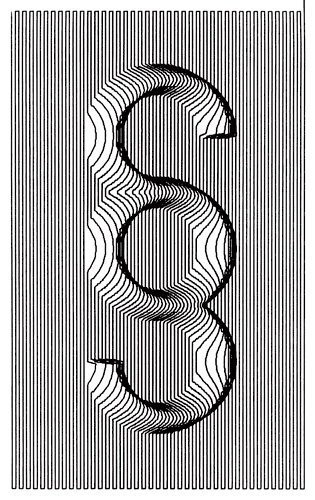 Computer Paragraph, 1971, 70 x 100 cm Offset lithograph obtained from an computer-generated drawing programmed by Sten KallinCourtesy the artist Index – The Swedish Contemporary Art Foundation is pleased to announce Sture Johannesson's second major solo exhibition in Sweden. The exhibition focuses on the breaking point that occurred in the late 1960s when Johannesson’s work moved away from the genre of Psychedelic Art and began experimenting with computer-generated graphics. The selection of works encompasses the poster series The Danish Collection (1967-69), presented together for the first time in Stockholm. The works were realized in the context of the Galleri Cannabis, an artist-run production and exhibition space started by Johannesson and his wife, artist Charlotte Johannesson, in 1965, which became a center for diverse social communities in Malmö. One of the eleven works, Revolution Means Revolutionary Consciousness! (1968), was commissioned by Lund's Konsthall to publicize the exhibition ‘Underground’, but soon became the pretext for repeated censorship of Johannesson's work. 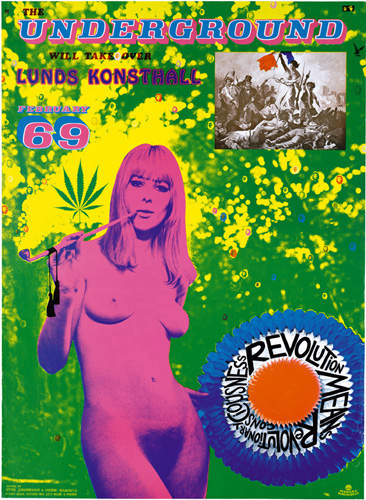 Revolution Means Revolutionary Consciousness!, 1968, 62 x 85 cm Lithography printed by Permild & Rosengreen Copenhagen Revolution Means Revolutionary Consciousness!, 1968, 62 x 85 cm Lithography printed by Permild & Rosengreen CopenhagenCourtesy the artist It was in the framework of psychedelia — a misunderstood artistic movement influenced by the counter-revolutionary and generational turbulences of the period, which suffered from association with hippie clichés — that Johannesson first became interested in digital drawings. Information systems and cybernetics were a logical development of psychedelia’s interest in self-organization, the technology of the drug, and media that proposed forms of artistic production able to ‘turn on’ and ‘off’ within or outside of established institutional frames that seek to ideologically regulate the social body. They worked towards dissolving the hierarchical and behavioral relations of a bureaucratized mass society, contributing to more egalitarian and interdependent relations, which could improve, for instance, the standard of living. For Johannesson, who in the early 1980s visited the Palo Alto Research Centre and Apple founder Steve Wozniak, digital media opened up new modes of pleasure that immunize the mind; they were autonomous vehicles defining other psychic, socio-political spaces created by us and no longer attached to a Freudian concept of the self. As production tools tracing correlations between constructed and programmed systems, computers could not be instrumentalized for ideological or poetical purposes, but could enable us to get closer to what we could not see. 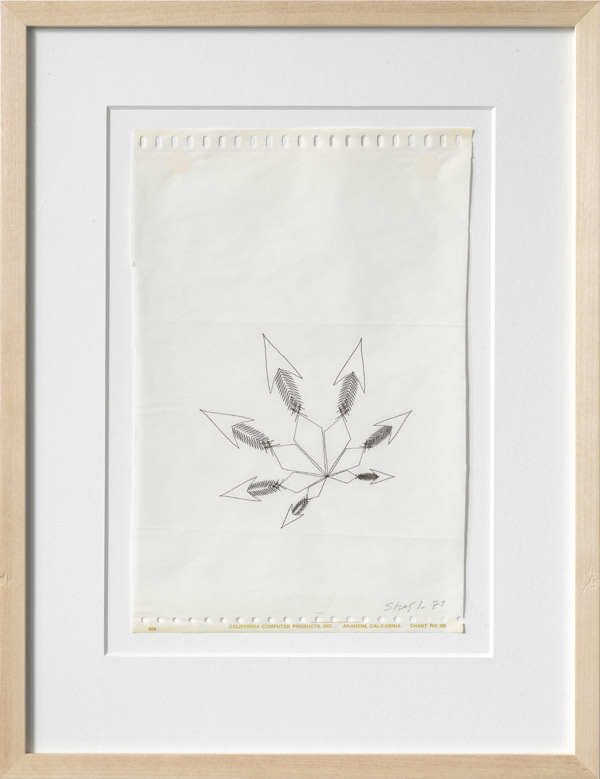 Intra Secus – Leaves, 1971 (variation 1) Computer generated drawings, IBM 1130 programmed by Sten Kallin, CalComp plotter Courtesy the artist The exhibition presents early graphic printouts realized between 1970 and 1975 in collaboration with the Swedish IBM programmer Sten Kallin. Series like Leaves (1971), Computer Paragraph (1971) and Yin-Yang (1975) are now considered pioneering computer works. All works were produced by cards fed into a screen-less 1130 IBM machine. Mathematical algorithms would produce culturally-conditioned images easily identifiable (cannabis leaves, legal paragraphs, yin-yang, etc.) on a CalComp drum plotter 30cm-wide paper roll. The programmed codes would intentionally de-personalize these motives, morphing symmetric data into multi-colored fields, occasionally accompanied by quotations from artists who deployed pre-digital ‘systems aesthetics’ such as Ad Reinhardt. Intra Secus – Leaves, 1971 (variation 1) Computer generated drawings, IBM 1130 programmed by Sten Kallin, CalComp plotter Courtesy the artist The exhibition presents early graphic printouts realized between 1970 and 1975 in collaboration with the Swedish IBM programmer Sten Kallin. Series like Leaves (1971), Computer Paragraph (1971) and Yin-Yang (1975) are now considered pioneering computer works. All works were produced by cards fed into a screen-less 1130 IBM machine. Mathematical algorithms would produce culturally-conditioned images easily identifiable (cannabis leaves, legal paragraphs, yin-yang, etc.) on a CalComp drum plotter 30cm-wide paper roll. The programmed codes would intentionally de-personalize these motives, morphing symmetric data into multi-colored fields, occasionally accompanied by quotations from artists who deployed pre-digital ‘systems aesthetics’ such as Ad Reinhardt. This routing process of perforated cards can be considered a sort of ‘memory’, an idea recovered by Johannesson to reveal a little-known and somewhat under-theorized piece of art history from the late 1960s, defined by the advent of the first computers. However, his exhibition title transforms this process into ‘memery’, taking its inspiration from Dr. Susan Blackmore. The British writer and psychologist argues that ideas replicate themselves from brain to brain like a virus, that humanity has spawned a new kind of meme, the teme, made of self-replicating ‘life forms’ spreading themselves via human consciousness by means of the technologies that we have created.¨
Sture Johannesson (b. 1935, lives and works in Skanör, Sweden) has exhibited widely internationally. His recent exhibitions include Antechamber/Salon by Dexter Bang Sinister at Kunsthal Charlottenborg, Copenhagen; New Jerseyy, Basel; Sociodelic Paths at Kraupa-Tuskany Zeidler, Berlin (solo); transmediale 2012, Haus der Kulturen der Welt, Berlin; The Inaccessible Poem, Fondazione Merz, Turin; Forms of Resistance at Van Abbemuseum, Eindhoven; Counterclockwise Circumambulation at Lunds konsthall (solo); A History of Irritated Material, A Study in the Ethics of Discomfort: Cannabis Gallery and A Cut in the Groin, Raven Row, London; Sensorialités Excentriques, Olivier Michelon, Musée départemental d'Art Contemporain de Rochechouart, Rochechouart; Bit International, Neue Galerie Graz, ZKM Karlshruhe, Germany; Strange I’ve Seen That Face Before, Museum Abteiberg, Mönchengladbach. He is currently one of the participating artists in the current group exhibition The Society Without Qualities on view at Tensta konsthall until May 26th, 2013.
|
|


