





 6 APRIL – 5 MAY 2002
Cecilia Lundqvist & Magnus Thierfelder
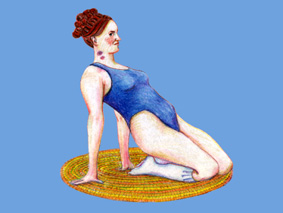 Emblem, © Cecilia Lundqvist 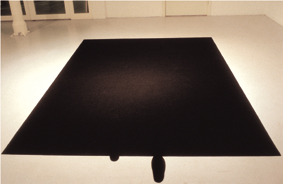 © Magnus Thierfelder Index presents two young artistic talents, Cecilia Lundqvist and Magnus Thierfelder, exhibiting separately in one show in the upper and lower galleries respectively. Index has previously shown work by Cecilia Lundqvist in the group exhibition "On Their Own" (2000) - a thematic show covering artists´ solitary and subjective methods of working. In Cecilia Lundqvist´s case, this method continues to be the process of animation, first with all the hallmarks of hand-made drawings, to then be digitally manipulated in an animation program where one drawing is related to another in order to create a whole narrative. These are tales of human relationships, about relations between people, or alternatively the solitary individual´s inner machinations with his or her self. And Cecilia Lundqvist is definitely not shy about bringing up life´s darker and more destructive sides. The "Emblem" film (2001) showing at Index, is included in a retrospective program about the artist organised by Moderna Museet, 7 May, as part of the contemporary film and video series. Cecilia Lundqvist graduated from Konstfack, Stockholm, in 1999. Magnus Thierfelder´s art combines a strict, reduced design with an ingenious spatial conceptuality. He is showing two works at Index, comments on the actual physical conditions of the exhibition space that sparsely accommodate themselves within the very same architecture. Magnus Thierfelder´s art is stylised and graphically evident, giving the impression, in part, of approaching a careful abstraction and in part, a careful figuration, striving to, in the artist´s own words, "show the importance of the unessential". Besides these spatial works, Magnus Thierfelder is also exhibiting drawings in the Index library, a one of a kind artist´s book. This is Magnus Thierfelder´s debut exhibition in Stockholm. He graduated from Konsthögskolan, Malmö, in 2001. From completely different motives, the art of Cecilia Lundqvist and Magnus Thierfelder challenges the kind of superficial, traditional demarcations that surround drawing as a means of expression. Together their art creates a composite image of the media´s possibilities: they have been chosen to exhibit together at Index not because they complement each other, but rather because their work unobtrusively "shadows" the other´s artistry. Cecilia Lundqvist in conversation with Helena Holmberg Magnus Thierfelder in conversation with Niklas Östholm Cecilia Lundqvist in conversation with Helena Holmberg Helena Holmberg: Can you start by describing why violence and power have been a continual focus of your work? Cecilia Lundqvist: I think power games between people are really fascinating things to study and reflect upon. As soon as people meet, they perform a kind of power game in order to discover their respective roles. This often happens in a matter of seconds, without us being aware of it. I often employ violence in the representation of these power games because there is always a certain degree of violence inherent in these situations. Sometimes explicitly, in the form of physical violence, sometimes deeply implicitly in the manner of the body language. The interpretation of this depends on people’s various experiences. My videos often utilise a strong hint of physical violence to clearly portray a variety of power scenarios. HH: In your previous work, it has mostly been the woman who has been violent, for example ‘Trim’, where a woman, in a studied and sadistic fashion, rips the pelt off a dog and then cuts off its tail. CL: The ‘Trim’ video is a reaction against people blindly accepting other people’s opinions, without any consideration for whether these are right or wrong. The woman in the video is reading a book that shows what a dog should look like according to other people’s norms. HH: There are other examples of self-inflicted violence, sometimes shown as one woman’s violence towards another. CL: I guess you’re thinking of the work ‘Absolutely Normal’, a video showing two identical women representing one person. In seven animations, they carry out passive or active metaphoric actions, which all symbolise and actualise a fictive separation of the human psyche. The purpose of the video is to reveal a variety of negative human behaviour and thus provide the observer with an occasion for self-reflection and insight. The title of the work acts as a reminder that all of this is completely normal. HH: Getting back to ‘Emblem’, I think of it as a work clearly dealing with violence and power issues. The man is shown reclining in a comfortable armchair, casually waving a piece of meat around, and it is the woman who has been abused. There is also a scene where we see a hand with brass knuckles punching a piece of meat. Quite clearly in this case, the man is the violent perpetrator. CL: Yes, but only symbolically. It is also possible that he is innovative and actually uses brass knuckles to tenderise his meat. HH: Your work almost always contains an element of ambivalence, something that is left unsaid. You leave the interpretation up to the observer. I thought your previous portrayals of violence directed at women were about relationships between people in general. Now when you use a man in the violent role, I see it as quite an explicit, almost political statement about the general balance of power between men and women. Would you agree with me that this has been your intention? Or is it, once again, up to observers to interpret it for themselves? CL: Obviously, my idea was to reflect the balance of power between two people, and naturally I have an underlying concept about what that’s about. An observer’s immediate reaction may well be to see the man as the perpetrator of violence, but there is also the possibility of turning the situation around and seeing the woman as the dominant party, because of her manner of neglecting him and therefore making him insecure. This is possible due to differences between physical and psychological strength. I am often ambiguous in my work, it gives a more truthful image of reality. There are always two sides to everything. HH: ‘Emblem’ emphasises the woman’s body and all those bruises. They look so real, it hurts. CL: It shows just how vulnerable the body is and in that way it seems more real. HH: In ‘Emblem’, we see the return of the one-piece bathing suit, something the woman in your work often wears. For myself and many women, the thought of being seen in a bathing suit is one full of anxiety. Why do your women wear them? CL: It’s an important point to note that I use the bathing suit, as well as the knee-length socks, to indicate a more ‘at home’ intimacy. That is, the woman is not in a public space, a beach for example. Another reason for using the bathing suit is simply the fact that it makes the figure easier to draw. HH: The woman in ‘Emblem’ seems to occasionally act like a dog, in that she lies on her back as well as lifts her leg as part of doing various exercises. In previous work, a scared, angry and repressed dog has played an important role. CL: I’ve used a dog in my work, utilising the submissiveness dogs have or are forced to have (whatever way you want to see it) towards their masters. HH: The woman appearing in your films is obviously you. In earlier films, ‘Trim’, ‘Disco’, ‘Party’ and ‘Chips’, it has been a rather stylised image, but here it appears to be more like a self-portrait. CL: The reason the figure / I changes appearance is to improve visually the way it fits into the specific narrative. In ‘Trim’, ‘Disco’ ‘Party’ and ‘Chips’ for example, I wanted, at first glance, to remind people of traditional children’s films. That’s why the main figure in these works is a simply drawn characterisation of myself. HH: Why have you chosen to work with your own image? CL: Primarily, the use of a figure that portrays me gives the freedom to do whatever I want with her, and no one else gets hurt. Another reason is probably that it is important for me to be personal. My figures are animated because it is easier for observers to identify with them. People who don’t know me, don’t realise it is often me in my videos. HH: The man in ‘Emblem’ has appeared in your work before. In ‘Rebus’ there is a sequence where he has two women sitting on his lap. Knowing that the woman is a self- portrait, one cannot help wondering if even the man represents someone in reality? CL: The man in these works is my late grandfather, who was very close to me when I was a child. I feel I can use his appearance and allow him to represent a big, physically strong man. HH: You have chosen to work with animated films – a slow and laborious technique. Can you describe how the work proceeds? CL: The first thing that happens is that there is something I want to say. Then I write a script and set up the various scenes with the aid of rough sketches. Then the slow animation work begins with all drawings. In some way I always use the computer for help, either by drawing directly with an illustration program or by scanning in images and reworking them in the computer. It’s during this long drawing process that the audio starts to evolve. I’m often thoroughly methodical and write long lists detailing what each scene needs. It’s a rough guess, but I think I only manage to make 7 – 8 minutes of animation in six months. I like the gentle nature of the medium. For me, animation is the ultimate means of expression. To just draw and tell a story. I’ve chosen to work with animation, primarily because it allows me to be personal, but at a distance. HH: In your earlier work, the narrative has seemed relatively restrained. Often you’ve kept to the TV-screen format, employing it as a kind of frame around your stories. You also worked with a sparse colour-scale, often just one or two colours against a black and white background. ‘Emblem’ seems to be an almost shocking raise in temperature. The colours are vibrant, the illustrated figures are much more naturalistic than before. And you’ve also departed from the TV screen and chosen to project your work in a room that is also part of the total concept. Despite ‘Emblem’ working with the same concentrated narrative as your previous works, would you agree that its tone represents a radical departure? CL: Perhaps that’s because the scenes originate from drawings representing bookmarks (illustrated figures on paper cut-outs). The bookmarks in themselves stand for small ‘singular situations’. The colours are different to my earlier work probably because the process started with the bookmarks, which required that style. Another reason is that the figures should seem more real, because the narrative I want to tell demands this. The room is part of the work because the sofa suite conveys a homey feeling. HH: You always make all the sounds and music yourself. Often the music consists of a repetitive loop or a kind of stylised pretend language, with the occasional decipherable word filtering through. ‘Emblem’ differs from previous work in that it contains comprehensible speech, a dialogue with a definite end. When the male voice says, “Well, put your clothes on” the story is at an end, quite definitely. CL: ‘Emblem’ is certainly the first of my works containing a comprehensible dialogue. My previous works were narrated through the body language of the figures and the actions they carried out. ‘Emblem’ has a dialogue because it was necessary for the narrative. The dialogue is sampled from an English language course. HH: What is your relation to audio and how do you employ it in your work? CL: Audio has become more and more important to me through the years. In the beginning, it was something I just added at the end, but I now realise how vital it is and it’s a large component of the work. I’m hoping to get more proficient in this area. HH: With this exhibition, we’ve chosen two artists who, in different ways, have a relation to drawing. What are your thoughts about this? Do you often draw? Does the drawing come first or the story? CL: Normally the story comes first, but it does happen that an incidental drawing forms the starting point of a story. In ‘Emblem’s’ case it was a drawing that came first. I like to draw, but I wouldn’t call myself an illustrator, because my drawings are not all that skilfully made. Sometimes an image is really good, but often they are quite unpolished. I employ images mostly as tools in order to get to what I think is the most important thing, my stories. Helena Holmberg 020405 Magnus Thierfelder in conversation with Niklas Östholm Entering Index, one encounters the final traces of a human disappearing into a black abyss. On the floor lies a carpet, its blackness and fabric fascinating viewers slightly. You move about the room, looking around. Further inside, along the long, white wall, a corner of the white cube appears to be peeling away, revealing a black undercoat, in the design of a mural portraying a turned up corner. With a strict, almost minimalist design, Magnus Thierfelder approaches the space through his drawings that are simultaneously abstract as well as figurative. In this case, the carpet is both a drawing and a sculpture. This and much more was the subject of our conversation, prior to the opening of Magnus Thierfelder’s exhibition at Index. Niklas Östholm: How did the work originate? And during the process of creation, what are your thoughts about art in general? Is it possible to speak of any general points of departure? Magnus Thierfelder: The initial inspiration to my works varies a lot. In terms of the actual presentation of the work, obviously, I consider how and where the work will be shown. It’s one thing to be in a gallery space and another to be elsewhere. Often something will make an impression on me, and then I’ll turn it around and around, so it gets seen from a different angle. I also allow my work to clarify its surroundings. For example, in the ‘Visit’ exhibition in Sölvesborg (1998) my main interest was in revealing the forgotten and the undesirable. By placing a greenhouse on a centrally located, perfectly mown lawn, I made a kind of refuge for everything living in the ground and allowed it to grow wild during the exhibition period. In creating these images, I often utilise a simple style in order to remove all that is unnecessary and attain a tightness of expression, where the design itself becomes the recognisable factor, and at the precise moment of recognition the viewer has to sharpen his powers of observation. NÖ: How did the carpet originate? MT: Initially the carpet idea began with an advert for a cleaning company in Germany, which I happened to see once. The carpet was dirtied by footsteps, however in the middle these disappeared or were washed out. I revised the image and in my version the carpet is completely black but with the outline of two footsteps entering one of the short sides, then vanishing into the darkness. What I’m presenting is a surface, a plane drawing in the shape of an everyday object. The carpet’s blackness indicates the absence of a space, a hole, while at the same time it is most palpably a flat shape. NÖ: What about the turned-up corner – if I can call your mural that? I associate it most with turning back a page, or peeking behind or ripping out a page. If the context happens to be a white cube, as is the case at Index, then interpretations may take an institutional-historic twist and so on. A seemingly small intervention affects the whole space. You mentioned previously that the origin of the work is rather banal, referring to school days and sitting in class drawing corners in notepads. Can you elaborate this? What about the other references you have for this work? MT: Well, the thing you mention about school is that it’s an image I drew in school books and I certainly wasn’t the only one. Probably it was a way of making the time pass, but also an almost unconscious expression of a desire to ‘turn the page’ and move on. In this case, I use it because, despite its simplicity, it changes the existence of the whole wall. And Index, an art gallery with white walls, floor and ceiling, lends the work additional impact. NÖ: I’d say that it doesn’t only transform the wall, but the whole room. If it is possible to say that the corner redefines the whole space, then what effect does the carpet have and what is its relation to the corner? MT: The carpet also redefines the space, but in a different way. Quite simply, it is a carpet on the floor with only a small detail differentiating from it from normal carpets? If the corner suggests a surface, then the carpet indicates a void. So together, they comment on the room’s existing structure. NÖ: Your method of working, both here at Index and in other contexts, is very spatial. What is your relation to the exhibition space, as a concept? MT: I think the exhibition space in itself is a rather interesting phenomenon, the supposition that it is a neutral area devoted to the presentation of art. Many times, art in its original form is more interesting, than when it’s taken out of its real context and into a concentrated situation at an exhibition and becomes more like a representation of something, but at a distance. On the other hand, the exhibition space provides an opportunity to create a concentration and a redefinition of things that would be impossible to achieve elsewhere. NÖ: At Index you’ll be showing two works which have been shown before, although never together. I was wondering, how do you usually work with a space, considering that your works often play with or against a room. Does the work or the space take priority in the way you work? MT: Certainly, there’s often some interplay between the idea and its portrayal within a space. But which one comes first is an open question. NÖ: Do you have various ideas that you collect and then want to try out in an (exhibition) space, and if so what do you look for in an exhibition space? MT: Certainly, you have a number of ideas that are generally based more or less on one and the same interest of investigating or showing something specific. For example, before one exhibition I visited the premises and found a stain on the wall near the ceiling. Its shape reminded me of the top of a palm tree, so I made this more apparent by drawing two really thin lines for the trunk, going all the way to the floor. So yes, there are ideas that are just waiting to be executed. And then the context greatly determines how the whole thing takes shape. NÖ: When I see your drawings, or for that matter a sculpture such as the carpet or the beaver tree (which I also associate with drawing), I think about something small (e.g. a sketch in a notepad, or a detail from a comic strip) that you’ve really blown up in scale. Viewing your work is like being a giant who has entered a comic strip, only to then feel like a midget in front of a huge detail (like a cartoon figure yourself). What’s your relation to comics? MT: Actually, I wouldn’t say I have any great relation to comics at all, although comics often use exactly the same kind of stylisation that I use to prompt recognition through design. But I select particular details, without creating a narrative. My images are like independent fragments. NÖ: What is your relation to drawing, in general? MT: For me, drawing is an easy way to execute a proposal or an idea. But it is also an opportunity to create simple, illustration-like images that contain more to them than meets the eye. NÖ: How do your drawings most commonly come about, where do you find the motifs? MT: I often use a digital camera, which quickly allows me to capture images in my surroundings, a kind of picture album, which often provides the basis for the drawings I make. The drawing reveals a concentrated version of ‘the usual’. NÖ: We are familiar in contemporary art with notions of the everyday and popular culture, and one can uncover references to these in your work (we’ve already talked a bit about it), but what’s your view on past ages’ murals, frescos and ‘trompe l’oeil’? MT: Obviously, there is a historical lineage to refer to, but actually, what’s of real interest to me is how the mural is interpreted within the space. And I can’t very well claim to be fooling the eye in this case. I think it is more about the existence of a desire or a need to be able to read images. And in that way, a simple, stylised image becomes a turned up corner, despite its simplicity. NÖ: As far as I know, many of your works are untitled. Why is that? MT: It’s mostly the recent works that haven’t been given any direct titles. These works depend so much on what the individual viewer perceives and reads into the work. A title would restrict the openness of a person’s perception. NÖ: You often highlight details in your drawings (and drawing-related sculptures; the carpet, beaver tree), motifs removed from their original context. What do you think of the general mass of images presented to us every day, and your images’ relation to this? MT: You can consider the mass of images as a chaos of information, in which it is difficult to focus on a single picture or detail. In my images and work, I want to promote and create a concentration that gets you to appreciate things that are so common, they often disappear in the sheer load of impressions thrust upon us. |
|


