





 8 APRIL - 21 MAY 2000
Anna & Bernhard Blume
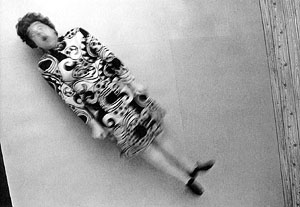 © Anna & Bernhard Blume The exhibition at Index comprises of two groups of work. One older, Natürlich, and the more recent Prinzip Grausamkeit. Natürlich is a work by Bernhard Blume from 1984 and Prinzip Grausamkeit is by Anna and Bernhard Blume from 1996 - 98. Natürlich is a more direct work with humour and absurdity clearly present, linking the pictures and the picture texts. The green colour dominates. Prinzip Grausamkeit. meets the viewer at another level and here the red colour spreads out. If Natürlich plays on the outer surface, then Prinzip Grausamkeit is about an inner. Index is also presenting other work by the Blumes in a non-stop slide show. The Blumes role-play, carrying out a kind of performance before the camera. They create their own kind of photography, one that is staged and highly subjective. The pictures also appear to be more spontaneous than what they really are. Many pictures have required a number of attempts before the right expression was acquired. In Prinzip Grausamkeit a lot has certainly been created in the technical post-production. Natürlich is typical of the Blumes in many ways. Through use of the absurd, our pre-conceptions about social roles and conventions are mocked. Elements of violence are not uncommon. There is a feeling of the ordinary attacking the ordinary. In the Blumes' world, a lot of things take flight. Subjects as well as objects are seen in contexts we wouldn't normally see them in and they are often flying. You could see this as a metaphor and food for thought; that we as people ought to take flight from our predetermined and culturally rigid roles and positions. But, you can also see it literally as a romantic idea, that objects are brought to life with a soul. Within Romanticism one believed that people, through communication with nature, could better understand the spiritual and mystical truths of the universe. In Prinzip Grausamkeit the investigation seems to have taken on an inner and more serious level. What is the body? What is the soul? What is the difference between them? Instead of endowing inanimate objects with life, as in Natürlich, here they turn living body parts into inanimate objects. Despite this, it is easy to perceive a hand separated from the body as being more alive when all our attention is focused on this one individual object, than when it is a part of a much larger whole. During their time as students at the Academy of Art in Düsseldorf, Germany, 1960 - 65, the Blumes came into contact with Joseph Beuys (both born in 1937 and began their studies at the same time). Through Beuys an interest began in neo-dada and Fluxus. After their studies at the Academy, Bernhard studied philosophy. He asked himself how one could create art by combining photography, performance, theatre and philosophy. After sporadic co-operation during the 70's, the Blumes decided to work together on a life-long photo-novel. Central to their work are themes as various as: German class-consciousness, the conventions of the middle-class, gender roles, paranormal phenomena, German Romanticism, the mechanics of photography, as well as the philosophical relationship between art and life. The everyday and the middle-class home often serve as points of departure for their work, although the Blumes are not absolutely critical of the German middle-class, which they believe themselves to be a part of. Their photographs are also their perception of themselves. Their work gives examples of who we are and what we do; as the Blumes play their roles, it demands that the viewer also questions the roles played in his or her own life. The absence of this self-reflection can be chaotic. Something which is apparent in Anna and Bernhard Blume's photographs. Niklas Östholm Curator student at Konstfack and intern at Index. Index wish to thank The Goethe Institut in Stockholm and Olof Glemme! |
|


