





 24 FEBRUARY – 25 MARCH 2001
Jonas Dahlberg
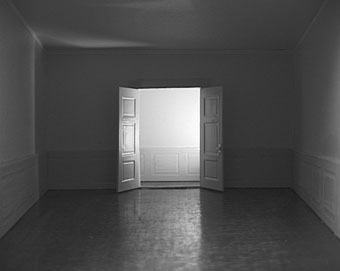 © Jonas Dahlberg, filmstill, scene 3 of 18 At Index, Jonas Dahlberg is showing two film installations originating from one and the same idea: the artist's interest in portraying spatiality with the aid of models in combination with film, an interest he has consistently researched for a number of years. A recurring element in Jonas Dahlberg's works is the methodology of surveillance. The role of a surveillance camera is to prevent crime and its presence testifies to a more abstract fear that exists in society. Jonas Dahlberg mentions in his notes, from his film in the 2000 Benthams Panopticon, the 19th century's prison structure where a centrally positioned observation post made it possible to survey every single prisoner, as well as instilling the concept that if one knew one was being observed, then one was disciplined. The artist has utilised the same architectural construction in the two films showing at Index, where a DV camera, rotating 360 degrees, is placed in the centre of a model structure. However the finished films accentuate the viewer and his gaze, rather than a paranoid insight of being subjected to continuous surveillance. In presentation, the scale of the filmed models shifts, by projection, to a 1:1 scale in relation to the exhibition space. This provides a more ambivalent relationship to reality and to the viewer, with associations to Wilhelm Hammershøis painted, low-key interiors and to cinematic precedents. These references cover both the mode of procedure current in cinematic practise as well as the films psychological content. Jonas Dahlberg´s film installations bear a distant kinship with the same sort of hypnotic effect that is experienced, for example, in Stanley Kubrick´s The Shining with the camera1s thrilling journey through a corridor system, or in Chantal Akerman´s more tranquil documentary-like narratives of hotel interiors in the film Hotel Monterey from 1973. Mats Stjernstedt Jonas Dahlberg's two works were produced in 2000 and 2001, the latter in conjunction with a studio scholarship at IASPIS (International Artist Studio Programme in Sweden). The Index exhibition is Jonas Dahlberg1s first solo show in Stockholm. He was born in Borås, Sweden, 1970, and presently lives and works in Stockholm. Jonas Dahlberg went to the Malmö Art School, 1995 - 2000, and he has also studied at the College of Architecture in Lund. Jonas Dahlberg1s two films will be shown this year at the Bovisa Contemporary in Milan, Italy, as well as a solo show at the Milch Gallery, London. A conversation between Jonas Dahlberg and Mats Stjernstedt Jonas Dahlberg in conversation with Mats Stjernstedt This conversation continued one year later in Nifcainfo #1/02, pp 15-17, "Under Surveillance, a conversation with Jonas Dahlberg". For further information, please visit http://www.nifca.org/ Mats Stjernstedt: You studied architecture for a couple of years before starting at the art academy. What made you change professions? Jonas Dahlberg: There were several reasons why I left. One was that I felt things were going too fast at the school of architecture. The projects were all too short: as soon as you finished one the next one started immediately. There was never any time for reflection, discussion, analysis or posing questions about what you had done and what it actually meant, other than whether it was 'good or bad / attractive or ugly'. I realised I was more interested in architecture or space from a psychological or political perspective: of using it as a way to describe something, quite simply what it means being a person in contemporary life. It was my experience that the architecture school wasn't interested in pursuing these issues and in general you seldomly see or read about anything like this from the world of architecture. And that's a shame. There was also a hierarchy among teachers and students. You were treated like a child and that really irritated me. So it just didn't feel right to me. After all, it is just a group of people and all of them, more or less, have a common interest in the same thing. Some of these people have greater experience than others and therefore often have something to say to those less experienced. But this is not always the case, especially if you aren't passionate about the same things. If you are discussing something that is totally uninteresting, then it doesn't matter if you receive positive or negative criticism about it. It still doesn't mean anything to you. MS: Would you agree that the relationship to authority is different in the art world, where you work for yourself on your own projects and not, as in architecture's case, working all the time on assignments for clients? JD: Yes, there is something to what you say. MS: Then how did you come into contact with the art context? JD: By coincidence I started playing football in a park with a group of people. It turned out that some of these went to the Forum Art School, that later became Malmö Art Academy. Sitting on the grass after our games, we'd talk about things and I discovered that there was in fact, other ways of viewing things, that there were other opportunities available. So I decided to apply for art school. At that time, I think I had never been to a single exhibition of contemporary art and I wasn't really thinking so much about changing professions. I made a sample of my work, something I had wanted to do at architecture school but couldn't do there and applied to Malmö Art Academy, because at that time I think it was the only school accepting that kind of work. No work on paper, no painting. And in a way, I think I still have not changed professions. I am still doing the same thing, even if it is now called art instead of architecture. But whatever label you choose is still relatively uninteresting, at least to me. I am only trying to say something and communicate something that is important to me. MS: Your interest in portraying spatiality with the aid of models combined with film and surveillance techniques is a recurring element in work after work. What is it about the model's design and this combination of forms that fascinates you and compels you to return to it again and again in your work? JD: Models allow you to realise fantasies and allow access to otherwise difficult environments. You are able to exercise control over situations as well as narratives. Models open a secret entrance to environments with a limited access, or visa versa. For example, in a hostage drama at an airport in 1976, a full-scale replica of an Air France plane was made in order to allow Mossad, the Israeli secret service, to experience and train in this environment before storming the aircraft. In the context of architecture, a model is never regarded as something exact. The blueprints detail the exact plans and the model is more like an idea about something, a representation of full-scale reality. At the same time, one of the fascinating things about models is that they simultaneously represent something and are something in themselves. They are unique, yet represent something else at the same time. They exist in the no man's land between space, object and image and may function as a mechanism shifting us straight into a controlled miniature world where scale is able to be freely disregarded, almost as it is in the world of film. Approximately in the same way as we continually experience what we see in the media in an incorrect formats. Models were once widely used in film, as they still are today yet not to the same degree, to realise impossible things: to carry out something that may have been economically impossible, such as a skyscraper blowing up or once again sinking the Titanic. Thanks to models, film is able to travel through history. It can show a ship from the 19th century sinking or a spaceship on a journey in the year 2400. Nowadays, a digitally constructed world is used for the same purpose, something that gives the model a relationship to the computer's world of virtual reality. Even if I do sometimes exhibit my models and utilise scale as an element in how my work is read, the model is still only a tool enabling the work to progress somewhere else. You miss quite a few levels of interpretation if you just stop at the model. MS: You were a student at the Malmö Art Academy in 1995 and from the very beginning, along with the models, you worked with aspects concerning surveillance as a reality and as a symptom of paranoia. I'm thinking about Safe Zones, a suggestive work that you commenced in 1995, traces of which can be seen in your current work. Can you say something about the unusual circumstances that made this work come about? JD: I moved into a new apartment around about the same time as I started art academy. Whoever was living across the street from me had plastered the walls of his apartment with a variety of weapons, such as hunting bows and arrows, crossbows and guns. I photographed his apartment from my window, mostly to provide some kind of evidence if in the future I was found shot dead in my apartment, then people would know what had happened. I couldn't really get it out of my mind, I mean if these were the kind of things he was deliberately showing, then what else did he have, or what was he doing, in the areas I couldn't see into...? These were the thoughts I had when I initiated this long project that came to be called Safe Zones. Maybe I should also say that I have never exhibited these photographs, although that is a rather dubious excuse for using a telephoto lens to photograph through someone else's window. At the same time, you could claim that whatever you see through a window is part of a public environment. Using the photos, I started to reconstruct my neighbour's apartment. I made exact drawings and built stylised scale models of what I couldn't see. I took what were his 'safe zones' and then also made a drawing of my own apartment. The drawing showed every possible angle of view between the apartments and this made me rearrange my apartment according to those zones that my neighbour couldn't view, so that suddenly my apartment would appear empty from his point of view. I then started to make some short films at home, where I tried to show simple everyday events in the context of moving from one safe zone to another. For example, one of the films is titled Safe Zones 1.To fetch a sweater. Such actions were suddenly extremely complicated to carry out. I showed this film at what was then Konstfack's student gallery, Service, in Stockholm 1996 and after the exhibition, when I returned to Malmö, the neighbouring apartment was empty. My neighbour had moved. For a variety of reasons, I also decided to move and when I'd totally emptied my apartment I went through it with a video camera. I then did a very similar sequence through a scale model of my apartment and showed the two films as a double projection at the Stockholm Art Fair, 1997. In a way that completed the project, but it had opened many avenues for me to continue working with, issues I had not begun to suspect when I started in 1995. MS: The purpose of a surveillance camera is to prevent crime, yet its presence also testifies to a more abstract fear held by society. You yourself have mentioned in an article the Bentham panopticon, a 19th century prison structure, where one centrally positioned lookout can see everything around it and that in itself, knowing that one is being observed, is considered a form of discipline. You utilised the same structure when you produced the two films that are now showing at Index, with a rotating camera mounted centrally in the model's structure. These sequences emphasize the observation and the observed rather than the knowledge of being observed, wouldn't you agree? JD: That's right. As you mentioned, I use the panoptic structure without actually discussing the panoptical observation. This is partly implied, although I'm not exhibiting any models at Index so the panoptical structure itself is not obvious. As well, the viewer is not aware that the camera is in fact moving in a circle. Rather you have the impression that it is a linear movement, moving from A to B, yet it never arrives at any B. You think it is moving in a certain direction, but after a while you discover that you have returned to the start again. It's almost like going backwards and forwards at the same time. The initial inspiration for this work came to me when I was working in Italy for three months. The people around me and the situation I was in started making me feel bad psychologically and I spent more and more time thinking about people and things in the past. I contacted several people from my home town, who I certainly hadn't spoken to in ten years. I can't quite remember what we talked about, but that's not important. I existed simultaneously in both the past and the present. After three months in Italy I couldn't stand it anymore, I was close to having a mental breakdown. At about this time, a friend sent me a novel by Jorge Lois Borges, about Funes, a man with an excellent memory, a man who remembered everything. And if he reconstructed a whole day, then it took him a whole day to do it. A memory loop, or a memory maze that becomes difficult to escape from. MS: What made you decide to rebuild the exhibition space at Index? Was it to convey a similar feeling, a kind of appreciation of the existing architecture? JD: By adding to the existing architecture in a way appropriate to the films, I tried to construct a situation where viewers would find themselves in the centre. Galleri Index has two floors and the first film, a 'vertical' trip through something that likens a kind of hotel, is seen by viewers when they have descended the gallery's staircase, when they still have this downward feeling in their body. In order to see the next film, viewers have to move horizontally into the adjoining room. The film allows viewers to continue this feeling of 'horizontal' motion. By making use of the architecture and by utilising the viewer's own movements, I think there is also a chance of leading him or her into my world and that it can be taken over by someone else. MS: Speaking about your work with film, you have said that you strive for a melancholic or lyrical feeling. What do these emotions mean to you personally? JD: It's about loneliness and that kind of vision you get on occasions of absolute loneliness. When everything feels completely strange. The absence of change is, of course, melancholic, as is the necessity of repetition or compulsion. At the same time, you could claim that nothing repeats itself, if you choose to focus on different things. This thought that each small change is capable of bringing a new possibility, could possibly be perceived as lyrical. The two filmpieces by Jonas Dahlberg has been realised during 2000 and 2001, the later at IASPIS (International Artist Programme Sweden) in Stockholm. The exhibition at Index is Jonas Dahlbergs' first solo show in Stockholm. Born in Borås 1970, Jonas Dahlberg is currently living and working in Stockholm. Jonas Dahlberg is educated at Malmö Art Academy, 1995-2000, and has also studied architecture at Arkitekthögskolan in Lund. During this year Jonas Dahlberg will participate with his two dvd-films at Milano Europa 2000, in Milan, and later in a solo show at Milch in London. Mats Stjernstedt is an artcritic, freelance curator and member of the curatorial committe of Index. |
|


