





 1 SEPTEMBER – 30 SEPTEMBER 2001
Gunilla Klingberg
Nonstop Unfold
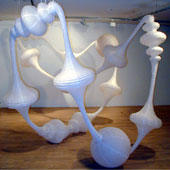 © Gunilla Klingberg Nonstop unfold, 2001 / Transtube system  © Gunilla Klingberg Nonstop unfold, 2001 / videostill from Unfold Index opens the season by exhibiting new works by Gunilla Klingberg. The artist's works comment on and rework specific commercial information, such as corporate advertising in the guise of logotypes that we are used to encountering daily in the urban environment, in the media and that regularly invade our private homes, so much so that we hardly notice it anymore. Gunilla Klingberg identifies the effects of materialism and how commercial forces continually strive to shape the individual and citizen into a consumer. At the same time, with the aid of computer graphics, she disarms this imagery by annexing it, manipulating it and transforming it into a decorative element, sometimes with distinct psychedelic features. All Lost in the Supermarket (1997-2000) is a series enveloping a wider context, featuring the artist's continual, subtle terror attacks: for Galleri Ynglingagatan, she exhibited Sparspace, taking as her point of departure the Sparlivs supermarket logo (1999), a project that continued with Sparloop, a video-animation shown at Index, among other places, the same year, as well as a German variation of Spar in the Personal Brandscape group show at the Migros Museum (2000). Nonstop Unfold, the new exhibition at Index, takes a similar route. However, reference is made directly to the objects we are supposed to find indispensable and expected to procure in order to guarantee our standard of living. Of course, in Gunilla Klingberg's world nothing is quite as it seems. The video piece Unfold contains documentary imagery that has been completely transformed, changing the otherwise familiar into completely unrecognisable, irregular shapes. The exhibition also includes the new sound piece Feedback Soundtrack, as well as Transtube System, which once had a function, but now has, thanks to the artist's attention, been effectively short circuited. A conversation between Gunilla Klingberg and Andreas Gedin Gunilla Klingberg studied at Konstfack, Stockholm, 1993-1997 and at RMI-Berghs, 1989. She has exhibited amongst others in the following solo- and group exhibitions: Seven-Eleven-Twist, Galleri Ynglingagatan 1, Stockholm, 1997, Special Offer, Salon3, London, 2000, What If - Art on the Verge of Architecture and Design, Moderna Museet, 2000, Cheap High, Modern Art Inc., London, 2000, Social Hackers, galleri Muu, Helsinki, 2000, and Forde espace d'art contemporain, Geneva, 2001, All You Can Eat, Galerie für Zeitgenössische Kunst, Leipzig, 2001. Gunilla Klingberg, together with Peter Geschwind, participated in the New Delhi Triennale, 2001. Gunilla Klingberg in conversation with Andreas Gedin Andreas Gedin: You work almost exclusively with company logos. How did it begin, I mean, it's quite a limited field isn't it? Gunilla Klingberg: I've made many works now, using supermarket logos, mostly from cut-price stores. One project was titled All Lost in the Supermarket where I used material from my own everyday existence, chewing over images and messages and spitting it out in another form. Since I had previously worked with graphic design, it felt completely natural to start with the store logotypes. In both our homes and in the urban environment, we are surrounded by advertising an marketing messages, which we are more or less aware of. The first logotype work I carried out was Seven-Eleven-Twist, 1997. Many 7-Eleven stores had opened up in Stockholm, often replacing small fruit and veg shops and tobacconists. Many 7-11's were open 24 hours. It's clear how quickly our habits change and create new needs, like buying eggs and cigarettes in the middle of the night. AG: You don't work with just any old logotype, nor are they such exclusive ones either? GK: I've been fascinated by a kind of basic requirement. Quite everyday things. The Sparlivs logo came to be used because it was where I bought my groceries - there is a store near where I live - a place you spend a lot of time in just to save a few cents. Price specials have a kind of attraction that I think is hallucinatory. When exhibited at Salon 3, situated in a shopping centre in London, I used the Tesco logo, the equivalent of Sparlivs: Buy One Get One Free. AG: Are there any complications in working as an artist and in working purely commercially, as a graphic designer, in the same visual art form? GK: It works all right. I mostly worked with magazines and catalogues, and there was never a conflict, except finding enough time to do everything. Problems can arise because in the so-called commercial world, you're working for a client and therefore it doesn't necessarily follow that you love what you're producing. Personally, I wouldn't wish to work with product advertising today, because it would have a complicated relationship to my art work. But generally, the border are a bit fuzzy. The art world is certainly commercial, too. AG: Tell us something about the way you work, in actual practice. For example, what kind of software do you use? GK: I often try to work in both digital and analogue. For example, I might make a sketch on the computer and then paint it by hand on the wall, or as with the video Spar Loop I used a lot of different programs (Photoshop, After Effects, Director, Final Cut) where each frame was made separately, like a cartoon. The video contains about 8 000 images, it becomes almost as a therapy producing such a work… But seriously I do like sitting with monotonous things which in their way can be meditative. AG: You have participated in a number of group exhibitions and often your work is defined as a critical statement about commercialism. GK: I question consumer society but I also want the work to convey different kinds of emotional states, something similar to a hypnotic state of being, like in the Spar Loop video, showing a pattern of supermarket logos that float around in a mandala-like shape. I would prefer my work to be seen as representing questions about, and reflecting upon, things in my daily life and what is happening across the street, rather than being a direct criticism. AG: Am I correct in assuming that you have mixed feelings about the range of goods available? GK: Yes, you could say that. When I was growing up, my mother worked as a dressmaker, so she made all my clothes for me for many years. But when I became a teenager, I wanted a pair of Levi's just like everyone else. Nowadays perhaps, I wish I had rather more handmade clothes, but I'm no good at sewing. AG: Your work is closely related to the visual art of the 60s, but instead of going for pop-minimalism or Flower Power, you work with logos, symbols of the market economy. Is this a conscience strategy, that your work reflects earlier artistic movements? GK: When I was about ten years old, in the mid-70:s, I had a teacher who drew psychedelic, Flower Power posters in black ink, and I loved them. If you look at my pictures, then there are some similarities in design with 60:s and 70:s art, but the inquiry, and the perspective, is different. The art movements you mentioned are American, and have a different significance for them, than they have for us. AG: You visited India recently with Peter Geschwind (artist and husband) and participated in the New Delhi Triennial. GK: We were invited to do an exhibition called Cheap High, a collaboration we've been working on for the last year, a sort of morphing of both of our works. We were in Delhi for three weeks gathering material: plastic bags carrying the logo of the local stores, from the sari boutiques in the marketplaces, the Nike store in the city, the lunch shop in Bengali Market, and so on. We taped them together to make large shapes, kinds of mushroom clusters, inflated by an industrial fan. We also made a video, which was a kind of diary, beginning on New Year's Eve 2001, the day we arrived in Delhi. AG: When we spoke in the spring, you mentioned that your experiences in India had, in some ways, changed your views about commerce. GK: India affects you in so many different ways. One example, regarding thoughts about consumption, is that their relationship to things is completely different. All garbage, everything thrown away, lives on, someone picks it up, fixes it or puts it together again. It's like an eternal recycling process. The way we waste our resources becomes so obvious. AG: You also mentioned that you'd been reflecting over how we in the Western world are concerned about over-consumption, while in India most people are striving to increase their consumption, naturally stemming from a position of want. GK: When it comes to consumption in countries such as India with such huge populations, and a huge middle-class, you see just how aggressively Western corporations are promoting themselves, launching products furiously through TV commercials and poster campaigns. Many people I spoke to confirmed that in recent years mobile phones and branded products have become much more common. It is probably easier to only think of the bad sides of consumer society, considering that we have lived in a welfare state, like Europe, for so long. But perhaps something else is missing, and I'm thinking about just how many Westerners go to India seeking some kind of spirituality. They want to leave the welfare state for a while and seek out harmony and perhaps spiritual happiness in a country where there are many such possibilities, but at the same time is one of the poorest nations in the world. AG: India and the 60:s seem closely connected: peace, love and understanding, both regarding the drug culture and a raised awareness of the evils of consumer society. All of that is close to you, I mean the interest in society and in th psychedelic. GK: Yes, in many ways. While still at the University College of Arts, Crafts and Design in Stockholm, I travelled to India to see Tibetan monks perform their ritual sand-mandalas in Dharamsala, and to visit the temples in Rishikesh, where there is an ancient tradition in yoga, familiar to us from The Beatles when they visited the guru Maharishi Mahesh. So certainly, what went on in India in the 60:s and 70:s has influenced me. I often employ a psychedelic expression, because it does represent what you mentioned. The raw material in my mandala-like images are commercial logos, which originally promise something quite the opposite to peace, love and understanding. I want to get to that conflict. AG: What are you exhibiting at Index? GK: I'm putting the finishing touches to a video, containing footage that I secretly filmed at IKEA as well as a sound installation, a loop with a small guitar amplifier, two effects boxes and a microphone that reverberates the feedback. It works as a live soundtrack to the video. Actually, I started thinking about this video in the autumn, 1999, when IKEA stayed open 24 hours, from midnight Friday to midnight Saturday, as a promotional gimmick. I went there that night to check it out and it was rather bizarre. Everyone was tired and irritated, dragging around screaming kids who were even more tired, running over themselves wit the trolleys, while a brass band played When the Saints Go Marching In. It was like a nightmare in there. AG: So the loop begins it all again, going around in a circle, around the clock? GK: Technically speaking, once it starts, the loop goes around by itself, and the whole time the noise it emits comes back to itself. And you certainly could say that it works a bit like some kind of 'instant karma'. |
|


