





 2003-09-03 – 2003 -10-05
Lara Almarcegui
Opening Wednesday, 3 September, 7 - 9 p.m.
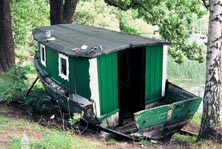 Lara Almarcegui, artist based in Rotterdam, spent July and August in Stockholm at the invitation of Index. During this period, she produced two new works, each based on the concept of public space. Lara Almarcegui always works on a small scale, avoiding the monumental tendencies that so often characterise public art. Instead she chooses to emphasise the social processes that are initiated when the cityscape starts to change, as a result of economical, political, or personal interests. Lara Almarcegui's first project for Index is an occupation and renovation of a dilapidated and abandoned boat of unknown origin and unsure future, that since the 1920s has been stranded on the banks of Årsta Bay in Stockholm. As a construction, it is a rare case that lacks any definition in Stockholm's otherwise strictly regulated urban environment (it has in its past in different periods served both as a boat and summer cottage) the artist has renovated it to its original condition in order for it to claim its rightful place in the public space. Her second piece is a slide documentation of an excavation she conducted on the outskirts of Haga Park, Stockholm, in an area that served as a gathering point for debris and demolition equipment, used for example in the infamous tearing down of the Klara city block in the 50:ties. Consequently, Almarcegui's work for Index investigates two areas: performance and concepts about spatial and material recycling. All works are time-based and, according to the artist, a kind of performance, since they are implemented by the artist in direct contact with the public that are in the space where she's conducting her artistic investigation. In 2002, Lara Almarcegui was part of the group exhibition 'Changing Places' at Index. Litterature on the artist in our bookshop: "Lara Almarcegui - demolitions, wastelands, allotment gardens" (Exhibitions International, 2003). Our gratitude goes to Årstavikens Segelsällskap and the Mondriaan Stichting. A CONVERSATION BETWEEN LARA ALMARCEGIU AND MATS STJERSTEDT, PLEASE SCROLL DOWN IN THE INDEX LOUNGE, during the same period: GORDON MATTA-CLARK Gordon Matta-Clark's much discussed artistic projects consisted mainly of radical surveys of architectural deconstruction, of the city's spatiality and its construction. From 1971 to 1977 Matta-Clark executed a number of films and videos about other large-scale projects in New York, Paris and Antwerp. In conjunction with Lara Almarcegui's exhibition at Index, we present Matta-Clark's films and videos, unmistakable deconstructions of architecture, including 'Splitting' and 'Bingo' (both from 1974), as well as the film about the collective restaurant 'Food', a much talked about meeting place for artists in Soho in the 70s, designed and built by Gordon Matta-Clark. Litterature on the artist in our library: 'Gordon Matta-Clark’ (Phaidon Press, 2003); 'The Space Between' (Nazraeli Press, 2003); 'Food' (Verlag der Buchhandlung Walter König, 2000). For more information and press pictures, please contact Index. The Index exhibition programme is curated by Andreas Gedin, Helena Holmberg, Mats Stjernstedt and Niklas Östholm A CONVERSATION BETWEEN LARA ALMARCEGIU AND MATS STJERSTEDT MS: Working with the city (environment) as a structure, your main interest lies with demolishing, wastelands and allotment gardens. What is the common denominator, or quality if you like, that makes these different components come together? LA: I like all those place because none of them fits with a design or plan made by city planners or architects. I consciously look for places that are not defined and that do not correspond with the will of politicians, developers and other professionals. After some research I found out that the only sites that are not the image of the city that authorities would want to give to citizens are wastelands, demolition sites and allotment gardens. A building before its demolishing fits a certain design But at the moment of the demolition it does not look as anybody want it to look. Wastelands are completely accidental and in them it is possible to see all kinds of processes that are hidden of the city. Allotment gardens interest me as self construction movements, since they have the look as each owner individually wanted. MS: This interest leaves an alternative and quite anarchistic suggestion to how the city should be interpreted, function and look. We know of other examples when these ideas are brought further to another level: I am thinking for instance of the strategy of squatting, or the reclaim-the-streets movement where the citizen's idea of the practical and ideological use of public space manifests itself. What is your relation to this political acclaim of the city environment? Sometimes you for instance use the same terminology in your work's titles. LA: It came as a consequence of the developing of my work: first I wanted to know a specific place very well; in order to do so I had to find different means to investigate it and get to know it better, which often demand of me to spend so much time as possible in this place. And the logic consequence of being a lot in a place is to claim it or to squat it. Regarding notion of anarchism, when I was still living in a Spanish provincial town I read Walden of H D Thoureau which immediately became the book I would refer most often to because it totally changed the way how to deal with space. Later in Amsterdam, people would explain to me that all Dutch hippies read it in the 70:ties and that he was the first architecture utopist. What influenced me the most here was Thoureau's his independence towards the notion of space, and his critique of how ownership made people into slaves of space. What I admire about him is not just his search of experiencing his own space while moving to the forest during two years, but the fact that he spent this two years in the forest actively writing about the process of doing his experiment Walden. MS: You mention your work as being related to performance, from where does this interest originate? LA: When I decided to make a project consisting of renovating a building, a market place, that was scheduled to be demolished, the art center that was producing the project proposed to me that I would get help from two men. I denied this, I preferred do the renovation by myself since I realized that it was more interesting and powerful as an idea of me alone on a scaffolding, trying to renovate a building before its demolition, rather than actually having a very nice and finished renovation. The process was more interesting for me than a perfect result. I guess that this was my first performance and I continue working with this idea, with the time of me doing something becomes the work itself. MS: The space that you choose for your performative work is mostly the public domain. If we think about performance here we would then also imagine an audience which in this instance could be the people inhabiting this public sphere, or just randomly moving through it. You also work semi-secretly, almost out of reach in remote places where there is very little interaction with an audience. How do you see your performative work function in these situations? LA: I work in very secret places if the subject I want to talk about is happening there: normally the most secret places are the allotment gardens or the self constructions. In those cases there is still an audience for my projects, the other allotment gardeners or owners of self constructions - which is a small but a very interesting one because they are the ones responsible for those kind of spaces. When I was digging on top of the mountain of debris in Stockholm there was also a small public but I think it was a direct communication since they too were standing on top of the debris hill.. But in any case all the actions can be explained easily after they are done. For example I like a lot the idea of somebody explaining to the family at dinner time that there was this person digging in the debris mountain today, or renovating the old boat along the seashore. Of course I explain my actions myself in publications, lectures and shows, I like a lot the way my actions become small stories. MS: The boat you refer to is the project you worked on this summer in Stockholm, "Squatting and renovation of a boat, Årstaviken, Södermalm, Stockholm, 6 August - 5 September", which consisted of you renovating a deteriated piece of architecture, sort of a crossbreed between a boat and a shed, now abandoned and with a to large extent unknown history. Why did you choose to focus this very specific little item within a big and complex city structure? LA: I choose the boat because it was simply the only really undefined place that I found in Stockholm. I loved the way it was placed in the shore and in the park landscape, occupying public space without asking for permission. The fact that it was so small gave me the possibility to really act and have an effect on it in a real way, though the action with the little boat is referring to the use of space in the whole city and the position of an inhabitant in a city towards its surrounding space, which is a much larger and somehow an universal subject. I believe that an act in a small scale, but 1:1, in a real scale, can be meaningful, and I also think that is how the people that were around experienced it: they were somehow touched by it because of the kind of beauty of the boat, of it being very exposed to its condition, but they also see a reflection on Södermalm and Stockholm, the neighborhood and the city where it was placed. MS: Stories rather than documentation then becomes an important strategy with which these works manifest themselves and disseminate. We may even speculate in that the amount of people you may encounter in public space in a few cases may actually surpass the amount of people that encounter your work within the walls of an art institution. But the visual component should not be underestimated: what do you think about this transition from public space to a more specific art context and how do you usually deal with this when showing your work in galleries and museums? LA: When I do my projects I am always thinking of what I want to talk about and then I find the way, for example if I want to know a place better I dig there to see what is below; later I would probably try to explain that I have been digging, and if it is a lecture I would just talk about it. If it is in an exhibition room I would need to explain this with a short text and with a few images, the same as in a publication. In this way the way to present the work by explaining the story gets adapted to the situation. But actually I never think too much about the public - which is probably naive - but I never have a clear idea of who my public is. I believe that it is a waste of time to find out who your public is since the public changes, it is alive and it chooses your work, it will create itself depending on the work you do. MS October 2003 |
|


